

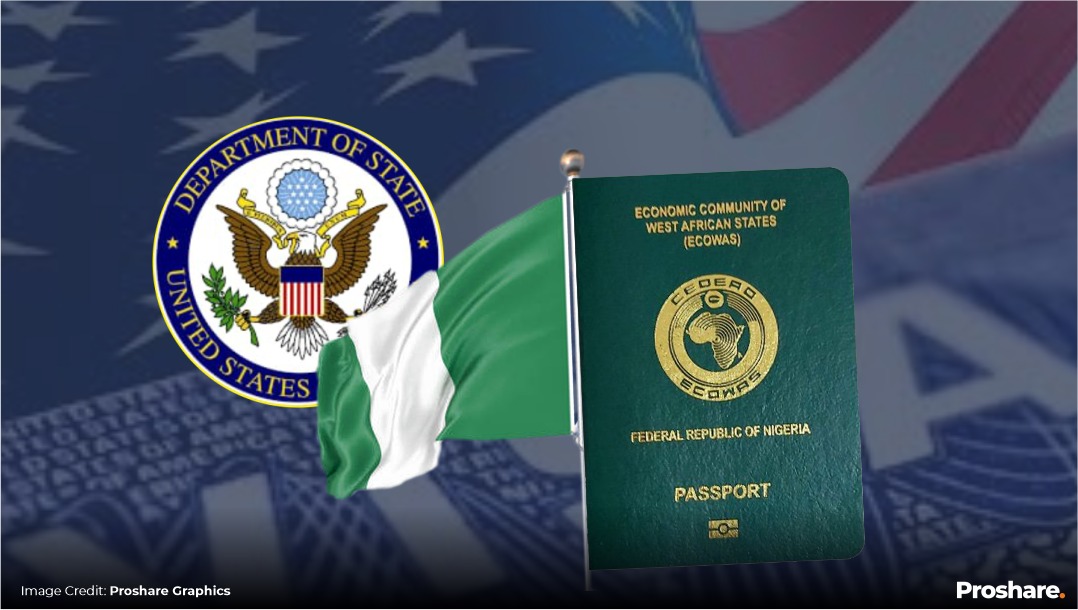
7.1.2026
In a bid to tighten visa applications the United States will require a $15,000 (about N21.7m) deposit from Nigerians and other nationals wishing to enter America with B1/B2 visas.
This and other travel restriction were unveiled by the US State Department for certain foreign nationals applying for B1/B2 visas for business or tourism purposes.
According to information published on the US Department of State’s website, Travel.State.Gov, the fees paid without the direction of a consular officer will not be refunded, and do not guarantee automatic visa issuance.
Of the listed nations, African countries accounted for 24 of the 38, including Nigeria, in the updated list released by the Department on Tuesday.
The Department of State said nationals from the listed countries have been identified as requiring visa bonds, with implementation dates shown in parentheses.
Countries affected include Algeria (21 January 2026), Angola (21 January 2026), Antigua and Barbuda (21 January 2026), Bangladesh (21 January 2026), Benin (21 January 2026), Bhutan (1 January 2026), Botswana (1 January 2026), Burundi (21 January 2026), Cabo Verde (21 January 2026), Central African Republic (1 January 2026), Côte d’Ivoire (21 January 2026), Cuba (21 January 2026), Djibouti (21 January 2026), Dominica (21 January 2026).
Others are; Fiji (21 January 2026), Gabon (21 January 2026), The Gambia (11 October 2025), Guinea (1 January 2026), Guinea-Bissau (1 January 2026), Kyrgyzstan (21 January 2026), Malawi (20 August 2025), Mauritania (23 October 2025), Namibia (1 January 2026), Nepal (21 January 2026).
The rest are; Nigeria (21 January 2026), São Tomé and Príncipe (23 October 2025), Senegal (21 January 2026), Tajikistan (21 January 2026), Tanzania (23 October 2025), Togo (21 January 2026), Tonga (21 January 2026), Turkmenistan (1 January 2026), Tuvalu (21 January 2026), Uganda (21 January 2026), Vanuatu (21 January 2026), Venezuela (21 January 2026), Zambia (20 August 2025), and Zimbabwe (21 January 2026).
In Nigeria’s case, the US cited the presence and operations of radical Islamic terrorist groups such as Boko Haram and the Islamic State in certain parts of the country, resulting in “substantial screening and vetting difficulties.”
The implementation dates vary by country, with Nigeria’s date set for January 21, 2026.
An overstay rate of 5.56 per cent for B1/B2 visas and 11.90 per cent for F, M, and J visas was also cited as a justification for Nigeria’s inclusion. As a result, the travel suspension covered immigrant visas as well as non-immigrant categories, including B-1, B-2, B-1/B-2, F, M, and J visas.