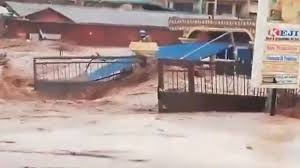

By Kingston Magare 3-6-2025
As Mokwa Niger State continue to grapple with the outcome of last week’s flooding the Minister of Water Resources and Sanitation, Engr Joseph Utsev has denied that released water from the Kainji and Jebba dams contributed to the devastation.
Speaking during a meeting with journalists Tuesday in Abuja Engr Utsev , said both dams are intact adding that what caused the devastation was simply because people refused to take warnings of the impending disaster seriously.
“The Federal Ministry of Water Resources and Sanitation extends its heartfelt sympathy and solidarity to the Government and the good people of Niger State, especially the affected communities in Mokwa, who have experienced losses, deaths and displacements as a result of this natural disaster.
“I like to emphasize that the flood was not caused by water releases from either the Kainji or Jebba dams and that both dams are intact and safe.
“We commend the immediate response efforts of the Niger State Government, local authorities, and first responders who have been working tirelessly to provide relief and support to the victims.
“The flood in Mokwa town was primarily caused by heavy rainfall due to extreme weather conditions occasioned by Climate change, an emerging Global Phenomenon which overwhelmed local drainage systems.
“Additionally, unregulated buildings and construction activities blocked an ephemeral tributary of River Dingi, a regressive river, a tributary of River Niger, which remains dry almost all year round with flows solely dependent on surface runoff by rainfall.
“The absence of efficient alternative pathways to redirect the excess water further worsened the flood’s impact on the communities.
“Nigerians would recall that the Federal Ministry of Water Resources and Sanitation through the Nigeria Hydrological Services Agency (NIHSA) in the 2025 Annual Flood Outlook (AFO), on the 10th of April 2025 predicted flooding in 19 LGAs of Niger state including Mokwa LGA.”
Meanwhile the death toll from the Mokwa flood disaster has reached 200 people, according to latest casualty statistics. About 500 people remain uncounted for.