

5-7-2025
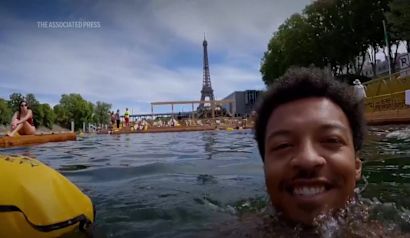
The River Seine reopened to swimmers on Saturday for the first time since 1923, with dozens of people taking a dip in the historic waterway.
It marked the first time since 1923 that bathers could take a dip in the iconic waterway following a years-long cleanup effort.
A few dozen people of all ages arrived ahead of the 8am (0600 GMT) opening of the Bras Marie swimming zone – one of three open in Paris this summer – donning swim caps and goggles as they prepared to dive in and celebrate the long-awaited return of bathing in the Seine.
“I thought it would be freezing cold but it’s actually great,” said Karine, 51, a care worker from southeast of Paris, and one of the first to jump in.
The seasonal opening of the Seine for swimming is seen as a key legacy of the Paris 2024 Olympics, when open-water swimmers and triathletes competed in its waters which were specially cleaned for the event.
“It’s a childhood dream to have people swimming in the Seine,” said Paris mayor Anne Hidalgo, who visited the site in the city’s historic centre near the Ile Saint-Louis.
“Look at how happy everyone is,” she said with a smile.
Parisians and visitors looking to cool off this summer can take the plunge – weather permitting – under the watchful eye of lifeguards in fluorescent yellow T-shirts at the three bathing sites, including one a stone’s throw from the Eiffel Tower.
The swimming zones are equipped with changing rooms, showers, and beach-style furniture, offering space for 150 to 300 people to relax, lay out their towels, and unwind from the city’s hustle and bustle.
“The water quality is “exceptional”, said Marc Guillaume, the prefect for the Ile-de France region that includes Paris.
“We are monitoring two bacteria, E. coli and enterococci, and for one we are ten times below the thresholds and for the other more than 25 times below,” he said.
But officials reminded swimmers of potential dangers, including strong currents, boat traffic, and an average depth of 3.5 metres (11 feet).
“The Seine remains a dangerous environment,” said local official Élise Lavielle earlier this week.
The promise to lift the swimming ban dates back to 1988, when then-mayor of Paris and future president Jacques Chirac first advocated for its reversal, around 65 years after the practice was banned in 1923.
Ahead of the Olympic Games, authorities invested approximately 1.4 billion euros ($1.6 billion) to improve the Seine’s water quality.
Since then, work carried out upstream promises even better water quality – with one catch.
On rainy days, the mid-19th-century Parisian sewage system often overflows, causing rain and waste waters to pour into the river.
Flags will inform bathers about pollution levels in the water every day, and if it rains, the sites will likely close the day after, said Paris city official Pierre Rabadan. AFP